M203 20260131 Sequence and Series
1. Arithmetic Sequences and Series
$\displaystyle A_n = A_1 + (n-1) \cdot d$
$\displaystyle A_n = A_m + (n-m) \cdot d$
$\displaystyle S_n = \frac{(A_1 + A_n) \cdot n}{2}$
1 ) The first term of an arithmetic sequence is $5$ and the sixth term is $40$,
find the $717$th term of the sequence.
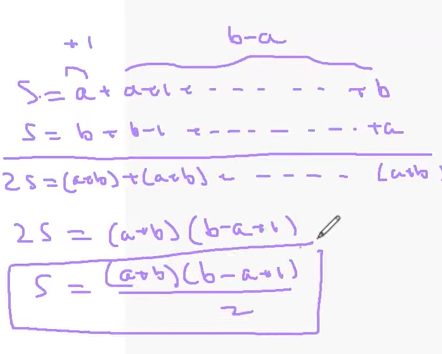
8 ) Let $a$ and $b$ be positive integers with $a \le b$. Find the sum of the positive integers from $a$ to $b$, including $a$ and $b$, in terms of $a$ and $b$.
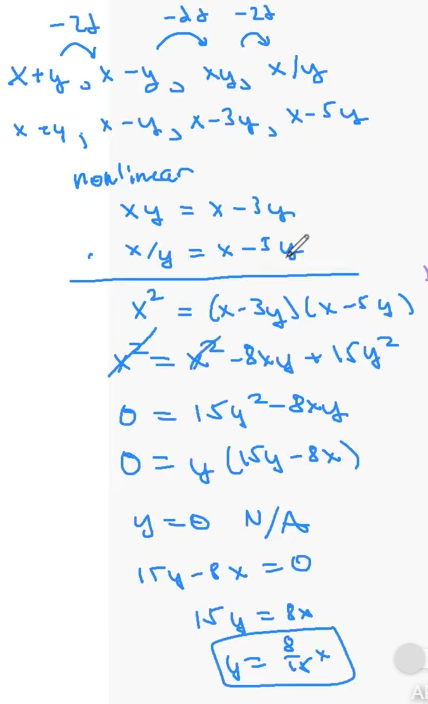
3 ) The first four terms of an arithmetic sequence are $x+y$, $x-y$, $xy$, and $x/y$. Find the fifth term in the sequence.
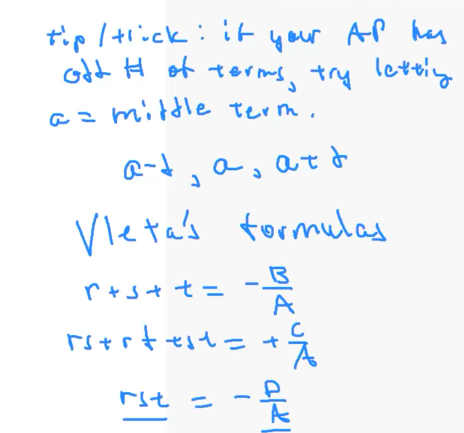
4 ) The roots of $64x^3 - 144x^2 + 92x - 15 = 0$ are in arithmetic progression. Find them.
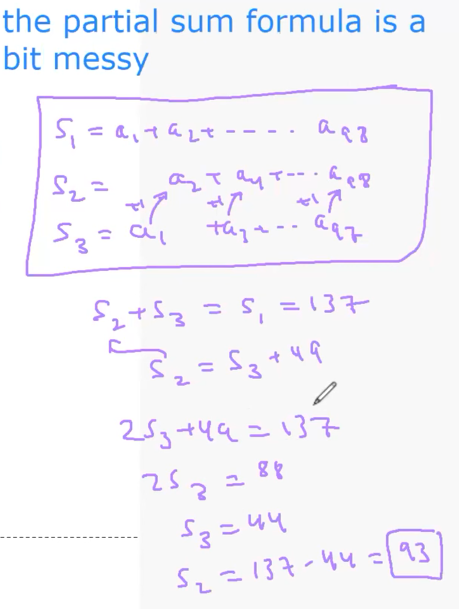
7 ) Let $a_1, a_2, a_3, \dots$ be an arithmetic sequence with common difference $1$,
and let $S_1 = a_1 + a_2 + a_3 + \dots + a_{98}$ and $S_2 = a_2 + a_4 + a_6 + \dots + a_{98}$.
Find the value of $S_2$ given that $S_1 = 137$.
9 ) Let $a_1, a_2, \dots$ and $b_1, b_2, \dots$ be arithmetic sequences such that
$a_1=25,\; b_1=75$ and $a_{100}+b_{100}=100$.
Find the sum of the first $100$ terms of the progression $a_1+b_1, a_2+b_2, \dots$.
Arithmetic Sequence
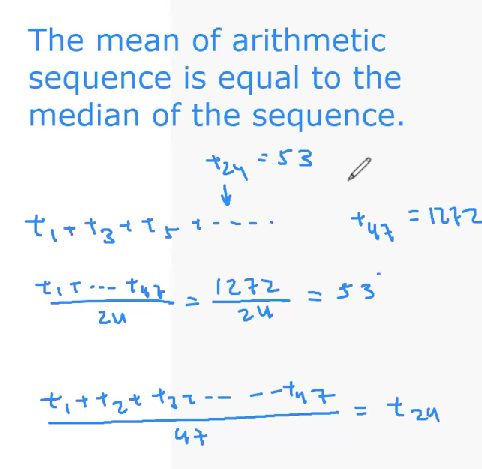
The mean of an arithmetic sequence is equal to the median of the sequence.
Sum and Mean Derivation
The sum of the first $n$ terms ($S_n$) is given by:
$$S_n = \frac{n(a_1 + a_n)}{2}$$
To find the mean, we divide the sum by the number of terms $n$:
$$\text{mean} = \frac{S_n}{n} = \frac{a_1 + a_n}{2}$$
Substituting the general term formula $a_n = a_1 + (n-1)d$:
$$\text{mean} = \frac{a_1 + [a_1 + (n-1)d]}{2}$$
$$\text{mean} = \frac{S_n}{n} = a_1 + \left(\frac{n-1}{2}\right)d$$
---
Finding the Median
The median depends on whether the number of terms $n$ is odd or even:
- If $n$ is odd:
The median is the middle term:
$$\text{median} = a_{\left(\frac{n+1}{2}\right)}$$
- If $n$ is even:
The median is the average of the two middle terms:
$$\text{median} = \frac{a_{n/2} + a_{n/2+1}}{2}$$
---
Examples
- Even $n$: $1, 3, | , 5, 7$ (Median is $4$)
- Odd $n$: $1, 3, 5$ (Median is $3$)
13 ) In an arithmetic sequence $t1, t2, t3, …., t47$, the sum of the odd
indexed terms is 1272. What is the sum of all 47 terms in the
sequence?
11 ) If the sum of the first $3n$ positive integers is $150$ more than the sum of the first $n$ positive integers. Find the sum of the first $4n$
positive integers.
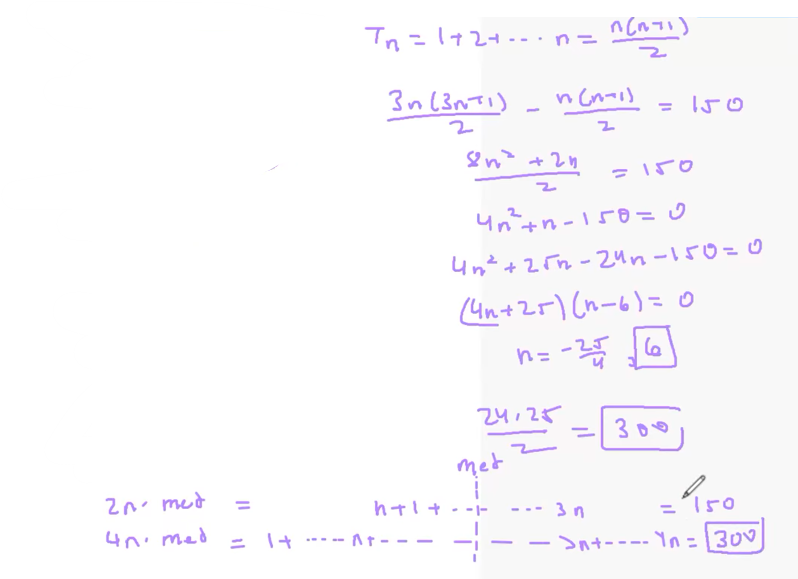
- The difference between the sum of $3n$ and the sum of $n$ is the sum of integers from $n+1$ to $3n$.
- There are $2n$ terms in this range $(n+1, \dots, 3n)$.
- The sum of these $2n$ terms is $2n \times \text{median} = 150$.
- By extension, the sum of the first $4n$ terms involves $4n \times \text{the same median}$, which logically doubles the result to 300.
2. Geometric Sequences and Series
$A_n = A_1 \cdot r^{\,n-1}$
$A_n = A_m \cdot r^{\,n-m}$
$S_n = A_1 \cdot \dfrac{1-r^{\,n}}{1-r}$
$S_n = \dfrac{A_1-A_{n+1}}{1-r}$
$S = \dfrac{A_1}{1-r}$ (for the infinite sequence and $|r| < 1$)
1 ) Suppose $x$, $y$, $z$ is a geometric sequence with common ratio $r$ and $x≠y$.
If $x$, $2y$, $3z$ is an arithmetic sequence, find the value of $r$.
2 ) A sequence of three real numbers forms an arithmetic progression with a first term of $9$. If $2$ is added to the second term and $20$ is added to the third term, the three resulting numbers form a geometric sequence. What is the smallest possible value for the third term in the geometric sequence?
7 ) Find the sum $\dfrac{1}{7} + \dfrac{2}{7^2} + \dfrac{1}{7^3} + \dfrac{2}{7^4} + \dots$
18 )Find the sum of the series $1 + \dfrac{1}{2} + \dfrac{1}{10} + \dfrac{1}{20} + \dfrac{1}{100} + \dots$, where we alternately multiply by $\dfrac{1}{2}$ and $\dfrac{1}{5}$ to get successive terms.
3. Recursive Sequences and Telescoping
A sequence $a_n$ is called preperiodic if it eventually becomes periodic after a certain point.
Definition:
$$a_n = a_{n+p} \quad \text{for all } n \geq N$$
Closed Form:
$$a_n = a_{n \pmod p}$$ Where $p$ is the period of the sequence.
A recursive sequence is defined by its preceding terms. The most famous example is the Fibonacci sequence.
Recurrence Relation:
$$F_n = F_{n-1} + F_{n-2} \quad \text{for } n \geq 2$$
2 ) Let $a$ be a positive constant. Consider the sequence defined recursively by $u_1 = a$ and $u_{n+1} = -\dfrac{1}{u_n + 1}$, for $n = 1, 2, 3, \dots$. Find the smallest positive integer $d$ such that $u_{n+d} = u_n$ for all positive integers $n$ and all possible values of $a$.
4 )A sequence of positive real numbers $a_1, a_2, a_3, \dots$ has the property that for $i \ge 2$, each $a_i$ is equal to the sum of all the previous terms.
If $a_{19} = 99$, then what is $a_{20}$?
Telescoping Series
A series where intermediate terms cancel out, leaving only the first and last parts.
Example Decomposition: $\frac{1}{n(n+1)} = \frac{1}{n} - \frac{1}{n+1}$.
Summation: $(\frac{1}{1} - \frac{1}{2}) + (\frac{1}{2} - \frac{1}{3}) + \dots + (\frac{1}{n} - \frac{1}{n+1}) = 1 - \frac{1}{n+1}$.
9 ) Let $n$ be a positive integer. Find the sum $\dfrac{1}{2!} + \dfrac{2}{3!} + \dfrac{3}{4!} + \dots + \dfrac{n-1}{n!}$.
4. Arithmetic-Geometric Series
An Arithmetico-Geometric Series is a series where each term is the product of an Arithmetic sequence and a Geometric sequence.
The Pattern
- Structure: Each term looks like $(\text{linear part}) \times (\text{exponential part})$.
- Example: In the series $S = \frac{1}{2} + \frac{2}{2^2} + \frac{3}{2^3} + \dots$:
- The numerators ($1, 2, 3, \dots$) form an Arithmetic sequence.
- The denominators ($2^1, 2^2, 2^3, \dots$) form a Geometric sequence.
How to Solve It
To find the sum, use the "Shift and Subtract" method:
1. Multiply the entire series $S$ by the common ratio ($r$) of the geometric part.
2. Shift the new series one position to the right.
3. Subtract the shifted series from the original $S$.
4. This creates a simple Geometric Series that is much easier to calculate.
1 ) Find a closed form for the series $1 + 2x + 3x^2 + \dots + nx^{n-1}$ for $x \neq 1$.
$S = \dfrac{1}{2} + \dfrac{2}{2^2} + \dfrac{3}{2^3} + \dfrac{4}{2^4} + \dots$.